Article Highlights
- Subsea inspections are essential for early detection of corrosion and fatigue type defects to support, prevention of catastrophic failures that risk environmental damage, and could cost millions in lost production.
- Asset integrity management and monitoring work together: management provides the strategy whilst monitoring delivers real-time data, with inspection validating fitness-for-service.
- ROV-deployed Non-Destructive Testing technologies can reduce inspection costs by up to 30% whilst cutting HSE exposure by over 80% compared to traditional diver methods due to the reduction of risk to life (divers). In addition, ROV-deployed technologies
- Can support a reduction in a clients carbon footprint, utilising smaller support vessels, and reduced personnel offshore.
When you’re managing offshore infrastructure worth hundreds of millions, the condition of your subsea assets isn’t something you can afford to guess at. Subsea asset integrity depends on knowing exactly what’s happening beneath the waterline, and that means regular, reliable inspection.
At Sonomatic, we’ve spent decades Supporting operators across the globe, maintain the safety and performance of their underwater infrastructure. From ageing North Sea pipelines to renewable energy foundations, the need for accurate subsea inspection has never been more pressing.
Understanding the true condition of these assets is fundamental to safe operations and regulatory compliance. Let’s look at why subsea inspection matters so much, what it actually involves, and how it fits into a broader integrity management strategy.
What Is a Subsea Inspection?
A subsea inspection is a systematic examination of submerged infrastructure to collect condition data that informs a client of the operational condition of the infrastructure in a challenging subsea environment. This includes pipelines, structures manifolds, risers, moorings, wellheads, and other critical components operating below the waterline.
These inspections gather information on wall thickness conditions, and the effects of corrosion on such infrastructure. Regular routine inspection can identify issues such as fatigue type crack formation, and corrosion rates. The data collected forms the evidence base for fitness-for-service decisions and helps determine when intervention or repair is needed.
Modern subsea inspection uses several complementary technologies:
- Visual inspection via ROV cameras captures general condition and identifies areas requiring detailed examination
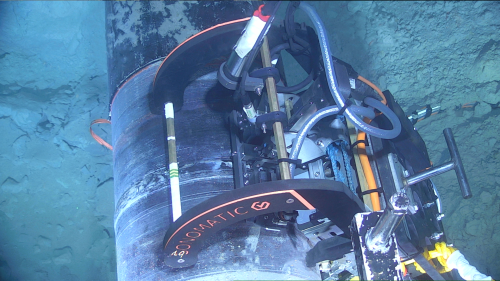
- Ultrasonic testing using various methods (PA/TOFD/DRS) measures wall thickness and detects internal/external defects with precision down to ±0.5 mm
- Alternating Current Field Measurement (ACFM) identifies surface-breaking cracks with very limited surface preparation
- Electromagnetic Acoustic Transducers (EMAT) inspect through coatings and marine growth
- Patented Magnetic Eddy Current (MEC) suitable for flexible riser inspections
- Pulsed Eddy Current (PECT) for inspection through concrete coated flowlines
The delivery method matters too. Whilst diver-based inspection was once standard, the industry has shifted decisively towards ROV inspection and Autonomous Underwater Vehicle (AUV) deployment.
Raw inspection data is just the starting point. Integrity engineers apply statistical analysis to determine minimum remaining wall thickness, predict remaining life, and calculate optimal re-inspection intervals based on observed degradation rates.
Asset Integrity Management vs Asset Integrity Monitoring
People often use these terms interchangeably, but they’re actually quite different things that work together.
Asset integrity management is the comprehensive process that governs how you look after your assets. It includes policy development, risk assessment, risk-based inspection planning, inspection execution, engineering assessment, repair decisions, and life extension strategies. Standards like ISO 55000 provide the framework for subsea asset integrity management programmes.
Management is strategic. It answers questions like: What are our integrity risks? Where should we inspect? How often? What acceptance criteria should we use? When do we repair versus replace?
Asset integrity monitoring, by contrast, is about continuous or periodic data capture. This includes online sensors, corrosion probes, strain gauges, vibration monitors, and other instrumentation providing real-time status information. Monitoring delivers the data points that feed into management decisions.
Management sets the strategy and decides what to do; monitoring provides ongoing visibility of asset condition. Both are required, but they serve different purposes.
Importantly, monitoring can flag anomalies and trends, but it cannot certify fitness-for-service on its own. Subsea asset integrity monitoring might tell you that corrosion rates are accelerating or that a particular section is experiencing unexpected stress.
But you still need inspection-derived evidence to quantify remaining wall thickness, characterise defect morphology, and determine whether the asset can safely continue operating.
At Sonomatic, we integrate monitoring data with high-resolution inspection services to close the loop. Monitoring tells you where to look more closely; inspection tells you precisely what’s there and what it means for asset integrity.
Why Subsea Environment Inspections Are So Important for Asset Integrity
The consequences of getting subsea integrity wrong are severe, both environmentally & financially. Here’s why regular inspection is non-negotiable.
Early detection prevents catastrophic failure. Corrosion, fatigue cracks, and weld defects don’t announce themselves until it’s too late. Subsea inspections catch these issues whilst they’re still manageable, dramatically lowering the likelihood of catastrophic failure.
Inspection optimises operational expenditure. Risk-based inspection intervals tailored to actual asset condition can reduce operating costs. You’re not over-inspecting low-risk areas or under-inspecting critical zones; you’re making data-driven decisions that balance safety with efficiency.
Environmental protection depends on it. Subsea leaks are among the hardest to contain. A rupture in a 1 km pipeline section can release a lot of hydrocarbons, with clean-up costs skyrocketing. The environmental and reputational damage can be even more significant. Inspection is your first line of defence against these scenarios.
Regulators expect documented evidence. The North Sea Transition Authority now requires every UKCS operator to evidence a risk-based integrity strategy. HSE Improvement Notices frequently cite inadequate subsea inspection records. Your inspection programme isn’t just good practice; it’s a regulatory requirement.
Life extension and repurposing need baseline data. As the energy transition accelerates, existing subsea infrastructure will be repurposed for carbon capture and storage (CCS) and hydrogen transport. Regulators insist on baseline integrity verification before any repurposing begins. Without comprehensive inspection data, you can’t make the case for continued or alternative use of ageing assets.
The global Asset Integrity Management market is projected to grow from US$23.9 billion in 2024 to US$31.5 billion by 2029, driven largely by ageing offshore infrastructure and tightening regulatory requirements. Meanwhile, corrosion costs the oil and gas sector over US$60 billion annually, with 15-35% of those costs avoidable through proven inspection and monitoring programmes.
Choose Sonomatic for Globally Trusted Subsea Inspection Services
When the integrity of your subsea assets is on the line, you need inspection services that deliver accurate, repeatable results you can stake critical decisions on.
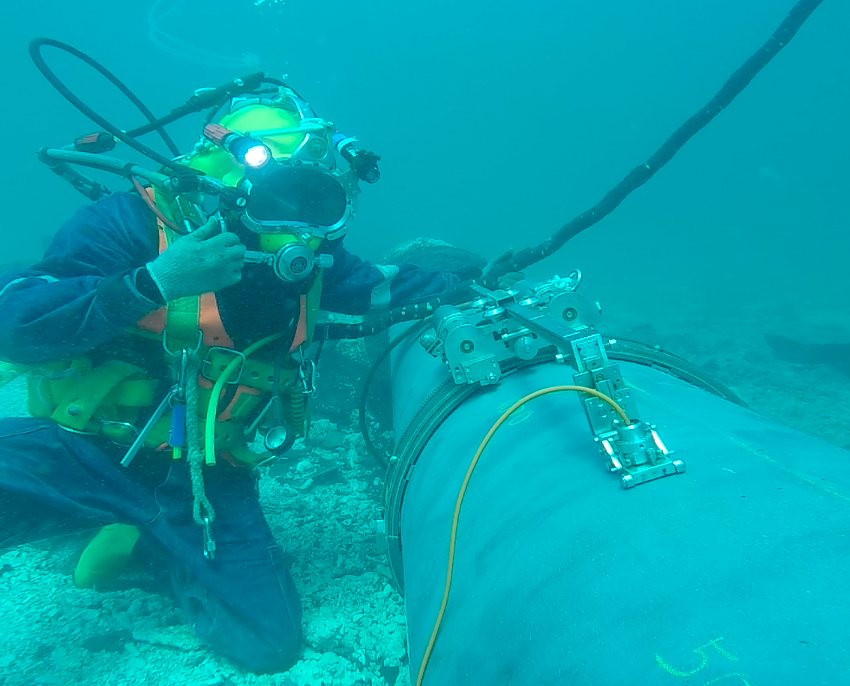
Sonomatic specialises in ROV-deployed and diver-deployed advanced Non-Destructive Testing, with all solutions developed in-house by our E2i R&D engineering division. Our proprietary technologies, including the NodeRay Scanner, deliver the high-precision data that enables informed decisions crucial to the safe continued operation of your assets.
With offices in Aberdeen, we offer same-time-zone support for North Sea operators, backed by global expertise from our teams in Houston, Perth, Abu Dhabi, and beyond. Our accreditations demonstrate our commitment to quality, safety, and environmental excellence.
Whether you’re managing ageing infrastructure, planning life extension, or preparing assets for repurposing, our integrated inspection and integrity engineering services provide the evidence base you need.
Get in touch with Sonomatic today to discuss how our subsea inspection capabilities can support your asset integrity requirements.
Frequently Asked Questions
How often should subsea pipelines be inspected for asset integrity?
Inspection frequency depends on risk-based assessment considering factors like age, operating conditions, corrosion mechanisms, and consequence of failure. DNV-RP-F116 recommends that inspection intervals be justified through documented risk-based inspection (RBI) methodology rather than fixed schedules.
Typical intervals range from annual inspections for high-risk sections to 5-10 years for lower-risk segments, with intervals adjusted based on findings from previous inspections and monitoring data.\
What technologies are used in modern subsea asset integrity monitoring?
Modern subsea asset integrity monitoring combines continuous sensor systems (corrosion probes, strain gauges, vibration monitors, acoustic emission sensors) with periodic ROV-deployed inspection technologies including advanced ultrasonic testing (Phased Array, Total Focusing Method), Alternating Current Field Measurement (ACFM), Electromagnetic Acoustic Transducers (EMAT), Dynamic Response Spectroscopy (DRS), Magnetic Eddy Current (MEC) (PEC) and visual inspection systems.
Digital twins increasingly integrate monitoring and inspection data to provide comprehensive asset condition visibility.
Can continuous monitoring replace subsea inspections?
No. Whilst continuous monitoring provides valuable real-time data on asset condition trends, it cannot replace periodic inspection.
Monitoring systems flag anomalies and track degradation rates, but they cannot quantify remaining wall thickness, characterise defect morphology, or certify fitness-for-service with the precision required for regulatory compliance.
Monitoring and inspection are complementary: monitoring tells you where to look, whilst inspection provides the detailed condition data needed for integrity assessment.
How do ROV inspections reduce CO₂ emissions from offshore operations?
ROV inspections eliminate the need for larger Dive Support Vessels (DSV’s) required for diver operations or hyperbaric habitats, significantly reducing fuel consumption, additional personnel, and associated emissions.
ROV campaigns can reduce overall inspection duration, further lowering the carbon footprint of integrity programmes.